
STOCKWATCH
The Stockwatch logistics intelligence platform helps reduce fixed asset investment related to system maintenance while improving operational availability.
Stockwatch is a logistics intelligence solution for inventory optimisation (spare parts, tooling and consumable materials)
Supply chain diagnostics and scenario simulation in the maintenance of complex assets: aircraft, defence vehicles, rolling stock, wind turbines and critical infrastructure. It turns operational data into a digital twin of the integrated support structure, enabling quantitative, evidence-based decisions that balance availability, shortage risk and fixed-asset investment.
What Stockwatch delivers
Supply Chain Performance Diagnosis
Understand how current stock levels translate into availability, shortage risk, and downtime.
Optimised provisioning strategies & optimum stock levels
Recommendations aligned to user-defined objectives (availability targets, max investment, risk thresholds).
What-If simulations & sensitivity analyses
Quantify operational and economic impact of changes in lead times, reliability, fleet operation, and cost parameters.
Multi-Base stock balancing
Relocation planning across depots (including interchangeable part numbers) to correct over/under stock efficiently.
Life-Cycle Cost Analysys
Long term maintenance cost analysis to estimate total fleet operational expense for the maintenance inventories across the supply chain.
Core capabilities
- 01
Optimisation Engine
Stockwatch builds a supply chain digital twin and applies an integrated optimisation approach for multi-level maintenance logistics support structures, leveraging an algorithmic backbone aligned with these support structures.
- 02
KPI-driven decision framework
Stockwatch focuses on four critical operational KPIs
- Material fixed-asset investment.
- Operational availability.
- Stock risk of shortage.
- Mean-down-time.
- 03
Visual master curves for strategic decisions
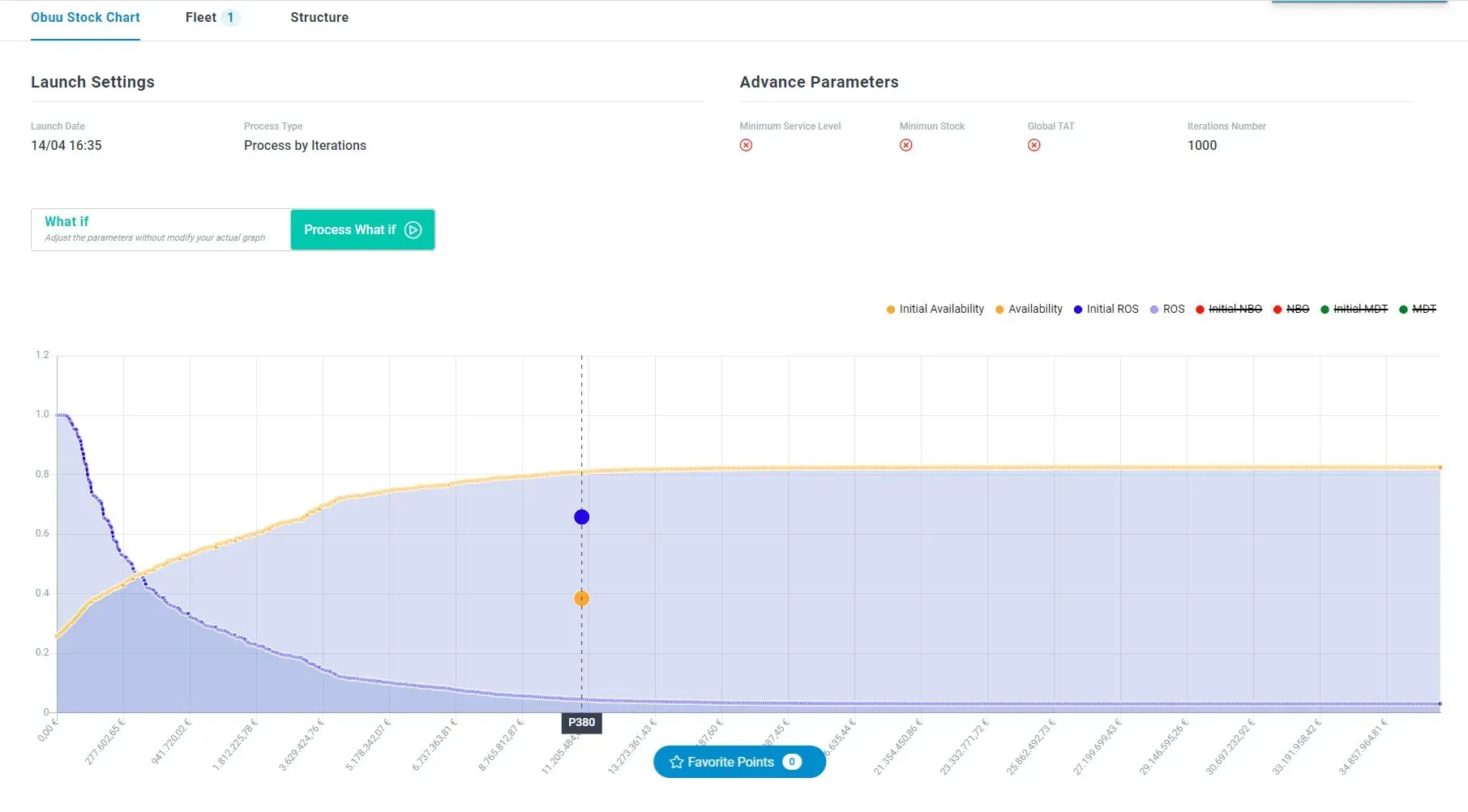
Results are presented through Cost vs Efficiency master curves, linking operational performance (y-axis) to investment (x-axis) and enabling fast strategy selection and comparison against the current baseline.
Key modules
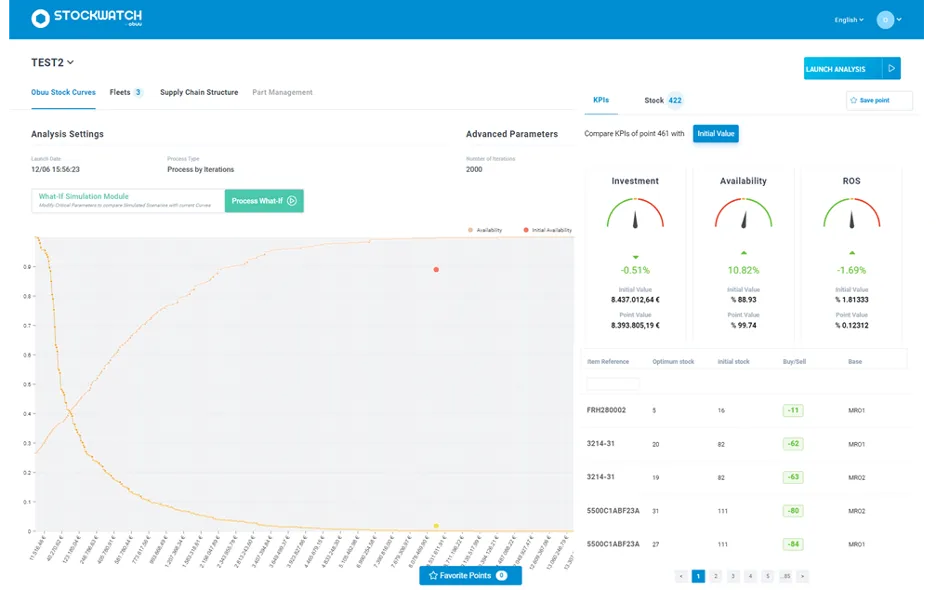
Supply Chain Diagnosis
Baseline assessment of current stock levels and their relationship to operational efficiency and fixed-asset investment.
Optimum Stock Levels & Provisioning Strategy
Defines target stock levels and deltas vs current, at global level and by base/material reference, including:
- Over-stock / shortage identification
- Service level & risk-of-shortage outputs
- Availability optimisation per base and overall network
Simulation & What-If
Simulate scenario changes and quantify deltas in both axes (investment/performance):
- Supplier lead times
- Acquisition cost
- Reliability/consumption rate
- System operation parameters
Includes
- Future event simulation
- Error amplification / sensitivity (to handle uncertainty in input data)
- Contract clause definition (quantify criticality of supplier performance parameters)
Multi-Base Stock Management
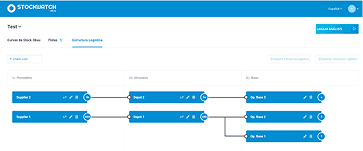
Creates a relocation plan between storage facilities to balance inventory using existing assets, explicitly supporting interchangeable part numbers.

Stockwatch relies on operational data across three areas (network structure, inventory/material, and fleet/operation). "Must-have" examples include:
- Network topology (warehouses, operating bases, interconnectivity).
- Supplier lead times, current stock levels.
- Material references, alternates, consumption rate/mean time between unscheduled removal (MTBUR).
- Fleet size and fleet operation parameters.
If data is incomplete, Stockwatch supports hypotheses and safety-factor analyses to mitigate uncertainty.
Automation & integration
- ERP integration options to automate periodic data upload/download and operational reporting.
- Option for real-time data feeds to produce dynamic results and support predictive maintenance contexts.
- Combination with STOCKVIEW to enhance with AI predictions.
Typical use cases
- Initial provisioning lists (IPLs) optimisation and strategy definition.
- Inventory balancing across multi-warehouse, multi-fleet environments (including interchangeable parts), scaling to 50k+ part references.
- "What-if" planning for changes in lead times, operational tempo, supplier performance, and reliability assumptions.
Logistics Intelligence Platforms
Stockwatch achieves an average improvement of these joint values for the specific KPIs.
0%
Investment Reduction
0%
Operational Availability Improvement
0%
Risk of Shortage Reduction